


The Manley Macro Memo April 2025
Executive Summary:
The S&P 500 reached an all-time high in mid-February, then fell by approximately 10%, ending the first quarter down 4.6%, marking its worst quarter since Q3 2022. The decline was driven by economic uncertainty due to the new administration's policies and weaker-than-expected economic data, leading to lower interest rates and a surge in gold prices. In April, the Trump Administration announced severe tariffs, causing a short-term panic in financial markets, which led to a 15% plunge in the S&P 500 and a significant increase in long-term interest rates. A week later, to soothe the financial markets, the Administration announced a 90-day suspension of the most severe tariffs to provide a window for negotiating new trade agreements.
Last year, the real economy grew by 2.5%, and the unemployment rate stood at 4.1%, significantly below its 60-year median of 5.6%. Despite solid economic figures in 2024, the economy is on an unsustainable path with a budget deficit of $2 trillion and a national debt burden of $36.2 trillion. The Trump Administration is taking steps to address these issues by reducing government spending and growing the economy through lower taxes and regulations, but this transition may result in short-term economic weakness. We are concerned that uncertainty over trade policy and a negative wealth effect from the market decline could push the economy into a mild recession, with the potential for a significant global recession if more severe tariffs are implemented.
We believe that stocks are in a bear market and offer a poor risk-reward because they are overvalued, there is significant economic uncertainty, and the estimated 10% earnings growth this year seems unrealistic. Over the next few months, we expect analysts to reduce earnings estimates as economic momentum declines, and valuations to fall as investors demand a higher risk premium in uncertain times. The magnitude of the bear market will be determined by the severity of the economic contraction and the amount of leverage in the financial markets. During this high-risk period, we are focused on preserving capital until the market offers a favorable risk-reward, with stocks being cheap, risk premiums high, and earnings expectations and investor sentiment low.
We have performed well and preserved capital year-to-date by maintaining a diversified and balanced portfolio that was underweight equities compared to our benchmark, avoiding the overvalued technology sector, and benefiting from investments in international stocks and gold. Fundamentally, we remain defensive because stocks offer a poor risk-reward, and there is significant trade and economic uncertainty.
To preserve capital during this high-risk period, we maintain a diversified portfolio that is underweight equities, has a 55% allocation to short-duration bonds, and investments in gold and other precious metals. In the long term, we believe that low taxes, deregulation, and incentives for capital investment will boost economic growth, lower inflation, and improve living standards. We are hopeful that tariff negotiations will yield a pro-growth trade policy and that we can avoid a deep economic downturn. We intend to maintain our defensive investment posture until economic conditions stabilize and equities offer a more favorable risk-reward profile.
2025 Year-to-Date Market Review:
After reaching an all-time high in mid-February, the S&P 500 fell by approximately 10%, finishing the first quarter down 4.6%. This represented the worst quarter for the S&P 500 since Q3 2022, when the Federal Reserve aggressively raised interest rates to combat inflation. The equal-weight S&P 500 and the Russell 2000 small-cap indexes decreased by 0.6% and 9.5%, respectively, in Q1, while foreign markets rallied as investors shifted their investments out of the U.S. —the MSCI EAFE International surged by 8.1%, and the MSCI Emerging Markets index increased by 4.2%.
After a strong 2024, the S&P 500 was poised for a correction due to overvaluation and inadequate diversification, as the “Magnificent 7” accounted for 33% of the index. The primary driver of the U.S. equity markets' Q1 selloff was the economic uncertainty created by the new administration’s economic and trade policies and some weaker-than-expected economic data. These economic concerns led to lower interest rates in Q1. The U.S. 2-year Treasury yield fell by 0.44% to 3.81%, while the U.S. 10-year Treasury yield declined by 0.24% to 4.34%. Furthermore, this economic uncertainty drove gold, the ultimate safe haven, higher by 19.7%.
The market decline accelerated in April when the Trump Administration announced its tariff policy on April 2nd. The “Liberation Day” tariffs were significantly more severe than expected, which led to a short-term panic in financial markets. Over the next four days, the S&P 500 plunged by 15%, the 10-year U.S. Treasury bond yield spiked by 0.37%, and the U.S. Dollar dropped by 2.5%. A week later, to soothe the financial markets, President Trump announced a 90-day pause on the most severe "reciprocal" tariffs with the notable exception of China. This temporary suspension began in early April 2025 and expires in early July 2025. The goal of the 90-day suspension was to provide a window for the U.S. and its trading partners to negotiate new trade agreements and potentially lower trade barriers. The Trump administration indicated that the higher tariffs could be reinstated if no agreements are reached by the end of the 90-day period.
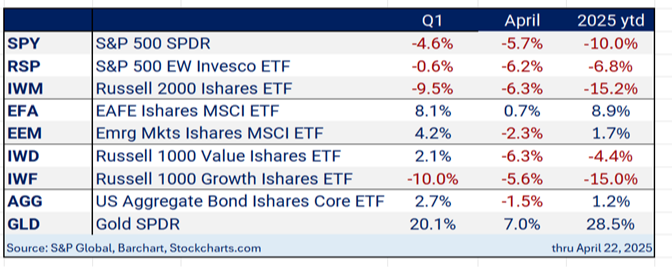
In Q1, the financial markets began to discount an economic slowdown. As the table below indicates, interest rates and stocks fell, while gold surged. The S&P 500's 4.6% decline stemmed from a 2.6% decrease in earnings expectations and a 2.1% decline in valuation. If the economy slows, equities are vulnerable due to overly high earnings expectations and excessive valuations.
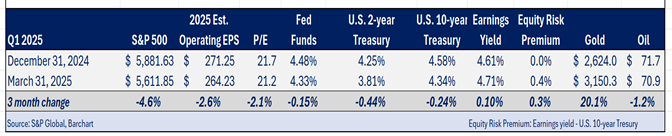
The economic data in the first quarter was decent, despite the volatility in the financial markets. Bloomberg's latest economic survey estimates that U.S. real GDP grew by 1.2% in the first quarter. The unemployment rate remained at a historically low 4.2%, and core inflation fell from 3.2% in December to 2.8%. According to FactSet, corporate profits grew by an estimated 7.2%, while revenue increased by 4.3%.
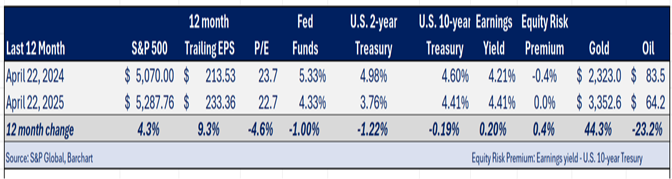
Over the past twelve months, financial markets' performance has been consistent with a slowing economy. Stock valuation, interest rates, and oil prices have declined, while gold surged by 44.3%. Interestingly, U.S. 2-year Treasury notes yield less than the Fed Funds rate, which indicates that the market expects the Fed to cut interest rates.
In our view, the S&P 500 remains unattractive despite the year-to-date sell-off because there is no equity risk premium compared to Treasury bonds. The S&P 500 has an earnings yield (earnings/price) of 4.41%, the same as the U.S. 10-year Treasury yield. Additionally, the S&P 500’s price-to-earnings (P/E) ratio based on trailing 12-month earnings is an expensive 22.7x. In a slowing or recessionary economic environment, the S&P’s P/E ratio should regress towards its 50-year average of 16.5x, implying a 27% market decline.
Economic Outlook
As value investors, our asset allocation is driven by long-term valuation measures and the risk-reward opportunities present in the market. Moreover, we analyze the leading economic and market-based indicators to determine the probable path of the rate of change for economic growth and inflation. This enables us to strategically position our portfolio to perform well in all economic environments.
Last year, the real economy grew by 2.5%, and the unemployment rate stood at 4.1%, significantly below its 60-year median of 5.6%. The primary drivers of the economy were government spending, AI-related investments, and high consumption by the wealthy. We believe the economy is vulnerable as these drivers diminish.
Despite 2024’s strong economic figures, the economy is on an unsustainable path. The budget deficit reached $2 trillion (6.1% of GDP), and the interest expense on our national debt amounted to $1.1 trillion (greater than our military expenditures). Our nation’s debt burden rose to $36.2 trillion (122% of GDP), while the inflation rate stood at 2.9% - significantly higher than the Federal Reserve’s 2% target. The Trump Administration is focused on reducing the budget deficit to 3% by cutting government expenditures and growing the private sector.
In January, a Chinese company released DeepSeek, an advanced and highly efficient large language AI model at a fraction of the cost of Western rivals. This breakthrough in efficiency led many to reassess their AI capital spending strategies, fearing that DeepSeek’s technological approach could accelerate the commoditization of AI.
Last year, the top 10% of U.S. earners—households making about $250,000 or more annually—accounted for nearly 50% of all consumer spending, significantly up from the 33% of spending thirty years ago. We expect the sharp market decline and economic uncertainty will result in an adverse wealth effect and reduced consumption among wealthy individuals.
The longer-term, structural economic issues we face today, such as excessive debt and ongoing inflation, stem from the Federal Reserve’s monetary policies following the “Great Financial Crisis of 2008.” In an effort to stabilize banks and boost the economy, the Fed kept short-term interest rates at 0% and injected trillions of dollars into the financial markets by purchasing government debt through Quantitative Easing. This zero-interest policy continued for nearly eight years after the financial crisis and persisted for around two years after the pandemic.
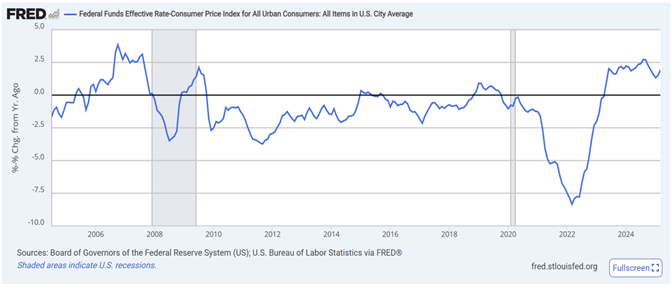
Additionally, the Fed’s reckless monetary policy kept interest rates below inflation for almost thirteen years after the GFC, which created many of today’s economic problems – too much debt, high inflation, and declining living standards.
The Federal Reserve’s reckless decision to maintain short-term interest rates below inflation for nearly thirteen years created many of our economic problems – too much debt, high inflation, and declining living standards.
Source: FRED
After the GFC, the Fed set interest rates at 0% to stimulate the economy by reducing borrowing costs and pushing asset prices higher to create a wealth effect – i.e., people feel wealthier, so they spend more. The Fed maintained a 0% interest policy for too long, keeping interest rates below inflation for nearly thirteen years. This reckless monetary policy aided the banks and debtors at the expense of savers and people on fixed incomes. This cheap money policy also led to a misallocation of capital as corporations were incentivized to borrow to buy (purchase other companies or buy back their stock), rather than build (invest in long-term productive assets and people).
When the pandemic struck in March 2020, the economy was unsound, driven by artificially low interest rates and elevated asset prices. To stabilize the economy during the economic shutdown, the Federal government spent $4 trillion, while the Fed printed $5 trillion to purchase government bonds.
budget deficit and a sizeable increase in national debt, further exacerbating inflation problems.
· Government spending has surged by 48% to $7.1 trillion (24.0% of GDP) since the Pandemic.
· The 2024 budget deficit was $1.8 trillion, or 6.1% of GDP.
· Federal debt increased by 56% or $13 trillion, to $36.2 trillion since the Pandemic.
· Consumer prices rose by 23.4% since the Pandemic
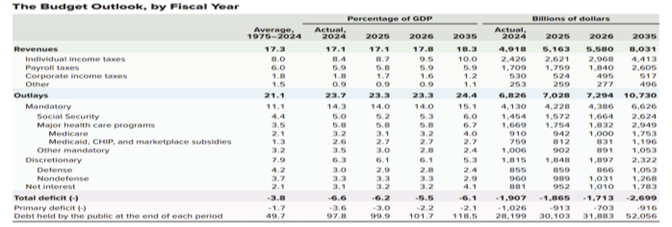
The budget deficit stems from high government expenditures instead of inadequate revenue. Over the last five decades, the median budget deficit has averaged 3.8% of GDP. Government spending has typically been around 21.1%, while revenue has averaged roughly 17.3%. In 2024, the budget deficit reached $1.9 trillion, or 6.1% of GDP, even with a low unemployment rate of 4.1%. The government's revenue of $4.9 trillion was near its 50-year average of 17.3% of GDP, while government spending was 23.7% of GDP, significantly higher than its 50-year average.
Source: CBO
The Trump Administration plans to reduce the budget deficit to 3% by eliminating government waste and fraud and reducing the size of government. They will keep taxes low and deregulate the private sector to grow the economy. Additionally, they want to increase energy production through deregulation to fight inflation and decrease interest rates.
U.S. Treasury Secretary Scott Bessent stated that as these policies are enacted, the economy will enter a “detox period” as it transitions from excessive government spending to a private-sector-led economy. He said that the economy and the market have become reliant on government spending, and now we must navigate this detoxification phase.
We are confident that low taxes, deregulation, and incentivizing capital investment, along with reduced government spending, will boost economic growth, lower inflation, and improve living standards over the long term. However, we are concerned that the “detox period” could become a recession as economic activity slows due to the uncertainty over tariffs and the adverse wealth effect created by the market’s decline.
The markets plunged by 15% after President Trump announced his tariff plan, which was more draconian than expected. After four days of plunging stock and bond prices, President Trump announced a 90-day pause on the most severe "reciprocal" tariffs with the notable exception of China. Despite the 90-day pause on the tariffs, significant uncertainty remains, which could hurt the economy.
The Administration’s tariff objectives remain uncertain, so their economic impact is unknowable. The strategies vary from encouraging fair trade by pressuring others to eliminate their trade barriers to implementing protectionism that imposes taxes on our trade partners to decrease trade deficits and motivating corporations to relocate production to the United States. Furthermore, tariffs might be used to bolster national security by lessening our dependence on foreign suppliers, particularly China, in essential sectors such as defense, healthcare, technology, and rare commodities.
In summary, excessive government spending and unprecedented peacetime budget deficits are unsustainable. We believe the administration is taking necessary steps to reduce government spending and grow the economy by lowering taxes and regulations while combating inflation through increasing the supply of energy.. We expect this transition to a private sector-driven economy will result in short-term economic weakness before the pro-growth policies lead to robust long-term growth. We are concerned that uncertainty over trade policy and the negative wealth effect from the market decline could push the economy from a “detox period” into a mild recession. Additionally, we anticipate a significant global recession if more severe tariffs are implemented.
Stock Market Outlook:
Stocks have entered a bear market, with the S&P 500 down 21% from its February peak and the “Magnificent Seven” mega-cap stocks falling 33% from their December highs. Historically, the S&P 500 bear markets averaged a 34% decline over nine to twelve months. While these large-cap leaders only recently crossed into bear territory, small-cap stocks, as measured by the Russell 2000, have faced a prolonged downturn. They remain 22% below their November 2021 record and have been effectively in a bear market for about four years.
We previously viewed the S&P 500 as offering poor risk-reward due to significant overvaluation, unrealistic earnings expectations, and a lack of diversification, as the Magnificent Seven represented nearly 35% of the index. Despite the recent sell-off, the index remains priced for perfection and offers poor long-term risk-reward.
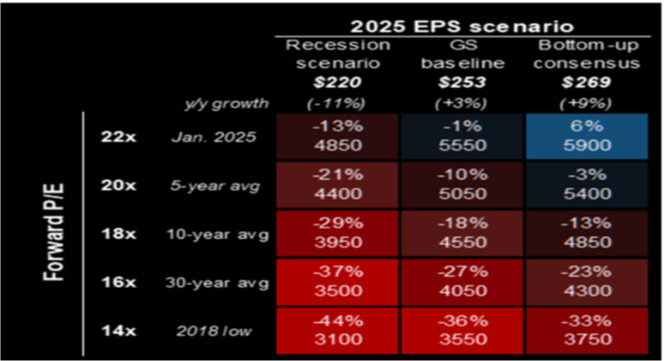
According to FactSet, the S&P 500's earnings are expected to grow by 10% in 2025, and the market’s P/E multiple is 20.2 times the estimated earnings, representing a 26% premium to its 30-year average P/E. We believe that 10% earnings growth is unrealistic because the economy’s primary drivers—government spending, AI capex, and consumption by the wealthy—are waning, and tariff uncertainty could push the economy into recession. Over the next three to six months, we expect analysts to reduce their earnings estimates as the economy slows, and valuations to regress to an average level as investors demand a higher risk premium given the economic and trade uncertainty.
Goldman Sachs created this table to show different outcomes for the S&P 500 based on various earnings estimates and the valuation or risk premiums demanded by investors in uncertain times.
As value investors, we believe that the price you pay most accurately determines your return on investment. While valuation models exhibit little predictive power over the short term, they correlate strongly with long-term returns over ten years or more.
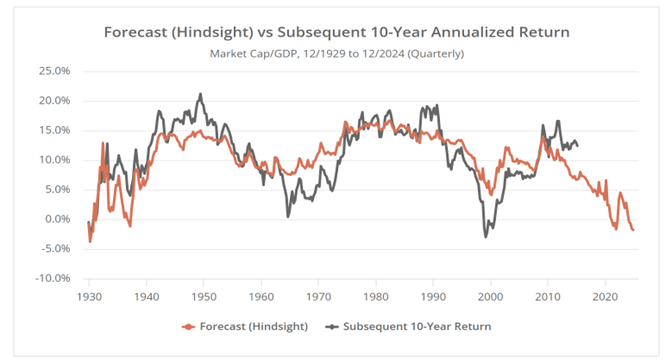
Despite the S&P 500’s 21% peak-to-trough decline and significant economic and trade uncertainty, the stock market remains very expensive based on long-term valuation measures. According to Market Value to GDP and Shiller’s CAPE valuation models, the S&P 500 is expected to return between -1.8% per annum and 3.0% per annum over the next ten years.
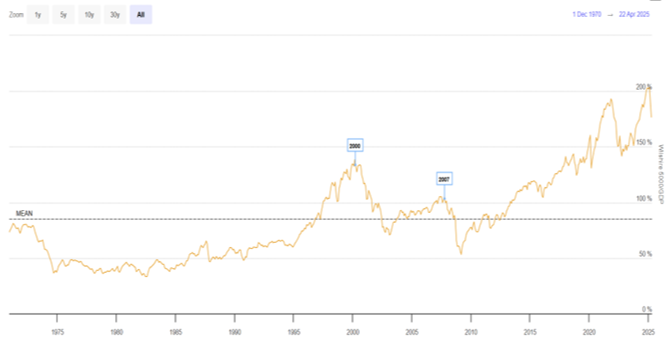
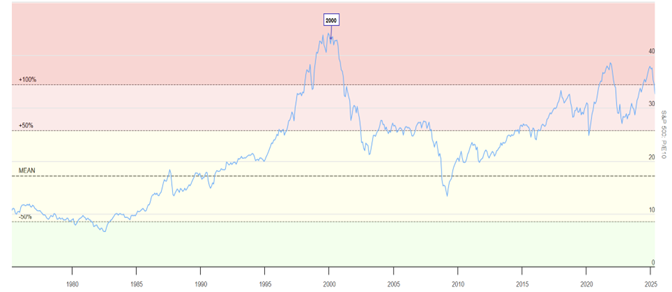
Market Value to GDP – "Still, it is probably the best single measure of where valuations stand at any given moment." –Warren Buffett, December 10, 2001. Based on market value to GDP, stocks are more than 100% higher than their historical average level and more expensive than during the 2000 technology bubble. Over the next ten years, the model forecasts an annual return for the S&P 500 of -1.8%.
Source: Longtermtrends.com, Allocate Smartly
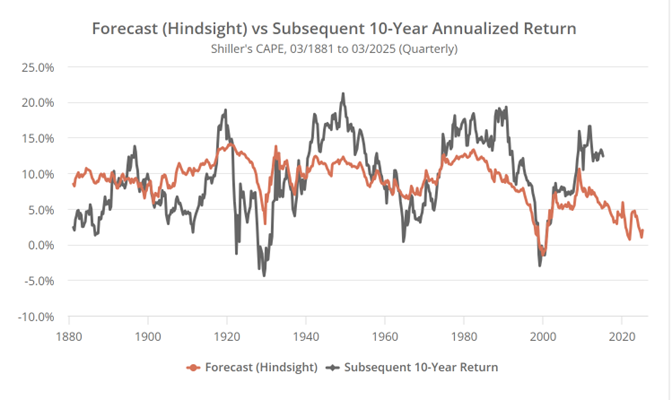
Shiller's CAPE (a valuation measure that smooths out cyclical earnings fluctuations) indicates that stocks are more than 90% above their long-term average, and the 10-year expected return is about 3.0% per annum. Since the 10-year Treasury Inflation Protected Securities (TIPS) yield a real return of 2.1%, the S&P 500 has an inadequate risk premium.
Source: Longtermtrends.com, Allocate Smartly
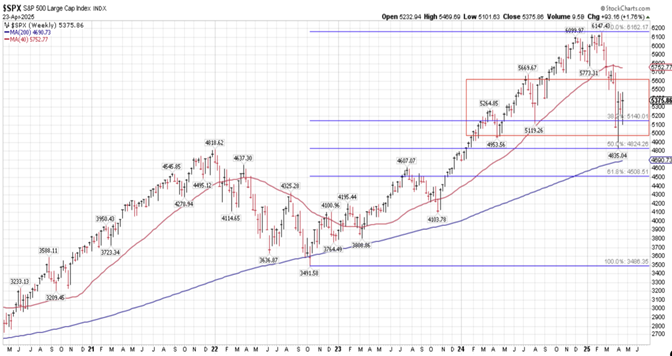
Our Tactical outlook (three months): We expect the S&P 500 to remain in a volatile trading range between 5600 and 5000 as the tariff negotiations occur. Then we expect another decline in the bear market as the economy slows and earnings expectations are reduced.
Source: Stockcharts.com
In summary, we believe that stocks are in a bear market and offer a poor risk-reward because they are overvalued, there is significant economic uncertainty, and 10% earnings growth this year seems unrealistic. Over the next three months, we expect analysts to reduce earnings estimates as economic momentum declines, and valuations to shrink as investors demand a higher risk premium in uncertain times. The magnitude of the bear market will be determined by the severity of the economic contraction and the amount of leverage in the financial markets. In this high-risk period, we are focused on preserving capital until the market offers a favorable risk-reward, i.e., stocks are cheap, risk premiums are high, while earnings expectations and investor sentiment are low.
Our Model Portfolio Review:
The benchmark for our model portfolio is the Traditional Blend — 60% equity and 40% bonds. Our goal is to outperform the benchmark with less risk. To outperform, our investment portfolio is diversified and economically balanced. We eliminate laggards and tilt the portfolio toward our location in the business cycle. Finally, to manage risk, we volatility-weight our positions and set a volatility target equal to our benchmark's historic risk level. When volatility increases, our asset allocation dynamically reduces our equity risk exposure. As value investors, our asset allocation is driven by long-term valuation measures and the risk-reward opportunities present in the market. Moreover, we analyze the leading economic and market-based indicators to determine the probable path of the rate of change for economic growth and inflation. This enables us to strategically position our portfolio to perform well in all economic environments.
The material in this newsletter is for educational purposes only and should not be considered investment advice or a recommendation of any particular security, strategy, or investment product.
Year-to-date, we have performed well and preserved capital in this challenging and volatile market environment. We believed stocks were priced for perfection, and the S&P 500 was at risk because it was overvalued and had significant concentration risk since 37% of its value was in seven mega-cap technology stocks. Additionally, we believed there was substantial economic uncertainty due to the unknown timing and magnitude of the proposed economic changes to fix the structural imbalances in the economy.
Our performance has been strong due to a diversified and balanced portfolio that had lower equity exposure than our benchmark. We steered clear of the overhyped and overpriced technology sector, which dropped nearly 30% amid the market downturn. Also, our investments in international stocks and gold, the ultimate safe haven, have yielded positive results, rising by 9% and 21%, respectively, year-to-date.
Fundamentally, we remain defensive because stocks offer a poor risk-reward, and there is significant trade and economic uncertainty. Also, to manage risk quantitatively, we set a volatility target equal to our benchmark's historic risk level. When volatility increases, our asset allocation dynamically reduces our equity risk exposure. Currently, market volatility is very high, so our risk exposure is reduced to maintain our volatility target.
To preserve capital in this high-risk period, we maintain a diversified and balanced portfolio that is underweight equities and has a 55% allocation to short-duration bonds that yield about 4.0%. Additionally, we are investing in gold and other precious metals that are performing well this year due to trade, economic uncertainty, and a weak dollar.
In the long term, we believe low taxes, deregulation, and incentives for capital investment, along with reduced government spending, will boost economic growth, lower inflation, and improve living standards. While a “detox period” is inevitable as we transition to a private sector-driven economy, we hope the tariff negotiations yield a pro-growth trade policy (fewer trade barriers) and we avoid a severe global recession.
We plan to maintain a defensive asset allocation until economic uncertainty diminishes and equities present a more favorable risk-reward opportunity.
Current Risk-Weighted Model Portfolio
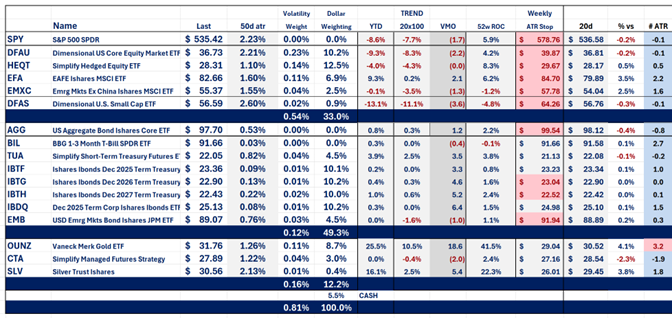
Our portfolio's risk level (annualized volatility) is 12.9%,
Our 60\40 benchmark has a historic risk level of 10.7%, and its current risk level is 24.6%.
Disclaimer:The material in this newsletter is for educational purposes only and should not be considered investment advice or a recommendation of any particular security, strategy or investment product. This newsletter is not a substitute for professional investment services. Past performance is no guarantee of future results, and there is no assurance that investment objectives will be achieved. Information contained herein has been obtained from sources believed to be reliable but not guaranteed.

