


The Manley Macro Memo January 2026
Executive Summary:
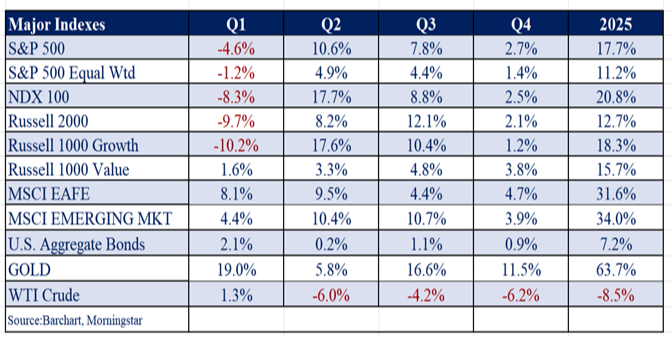
A resilient economy, strong corporate profits, and the Fed’s three additional interest rate cuts drove the S&P 500 to an all-time high in the fourth quarter. In this risk-on environment, the S&P 500 advanced 2.7% in the fourth quarter, while the equal-weighted S&P 500 and the Russell 2000 small-cap indexes gained 1.4% and 2.1%, respectively. International equities maintained their leadership, with the MSCI EAFE Index up 4.7% and the MSCI Emerging Markets Index rising 3.9%.
Despite a sharp 21% tariff-induced correction in March and April, the S&P 500 rallied 17.7% in 2025, as trade tensions moderated, the Federal Reserve continued its easing cycle, and corporate earnings exceeded expectations—fueled primarily by the AI capital expenditure boom. Market leadership remained narrowly concentrated in technology and communication services, the two sectors positioned to benefit most directly from the unprecedented surge in AI-related infrastructure spending.
We believe that the economy is more vulnerable than the headline numbers suggest. The U.S. economy's solid 2025 growth rests on three unsustainable pillars: near-record peacetime deficits (5.8% of GDP), AI capital spending driving 39% of economic growth, and consumption concentrated among the wealthiest 10% who benefit from the AI boom and the Fed-inflated asset bubbles. The AI mania exhibits classic bubble characteristics, while the economy has grown dangerously dependent on the wealth effect from inflated asset values. We are concerned that the Trump administration's "run it hot" strategy and the Fed’s easy monetary policy could push interest rates higher than the fragile economy can withstand.
Our long-term view is that stocks offer a poor risk-reward, because overvaluation is extreme and the S&P 500 has significant concentration risk, as ten mega-cap technology stocks account for 38% of the index’s market value. Additionally, gold’s epic rally, which continues in January, signals structural problems and is not a positive for risk assets. In the short term, the market’s recent breadth improvement and the relative strength of economically sensitive sectors are noteworthy. Typically, a broad-based rally is a sign of a healthy market. We are concerned that this leadership rotation away from tech may signal the beginning of capital flight from overvalued tech sector and the initial stage of the AI bubble bursting.
Our portfolio is positioned for reflationary conditions—rising nominal growth paired with elevated inflation. We are invested in assets with historically favorable performance in such environments: international and EM stocks, value equities, hard assets including gold and commodities, and short-duration fixed income to mitigate rate risk. This allocation seeks to participate in short-term policy-driven economic momentum while maintaining hedges against the structural fragilities: unsustainable deficits, speculative AI investment, and consumption dependent on inflated asset prices.
Fourth Quarter 2025 Market Review:
A resilient economy, strong corporate profits, and the Fed’s three additional interest rate cuts drove the S&P 500 to an all-time high in the fourth quarter. In this risk-on environment, the S&P 500 advanced 2.7% in the fourth quarter, while the equal-weighted S&P 500 and the Russell 2000 small-cap indexes gained 1.4% and 2.1%, respectively. International equities maintained their leadership, with the MSCI EAFE Index up 4.7% and the MSCI Emerging Markets Index rising 3.9%.
Despite a sharp 21% tariff-induced correction in March and April, the stock market delivered strong full-year returns as trade tensions moderated, the Federal Reserve continued its easing cycle, and corporate earnings exceeded expectations—fueled primarily by the AI capital expenditure boom. Market leadership remained narrowly concentrated in technology and communication services, the two sectors positioned to benefit most directly from the unprecedented surge in AI-related infrastructure spending.
The "Magnificent Seven" mega-cap technology stocks rallied 24.9% for the year. Since these seven companies represent approximately 36% of the S&P 500's total market capitalization, the S&P 500 increased by 17.7%, while the equal-weight S&P 500 advanced by only 11.2%. Additionally, the S&P 500 benefited from record U.S. corporate buybacks by mega-cap stocks, which exceeded $1 trillion for the first time. Market breadth was poor in 2025 – the median S&P 500 stock appreciated 8.7%, and nearly 40% of the 500 companies had negative returns.
International and Emerging Market equities significantly outperformed U.S. stocks in 2025, with the MSCI EAFE Index and the MSCI Emerging Markets Index gaining 32% and 34%, respectively. Foreign stocks benefited from favorable valuations, the weak dollar, and investors seeking to diversify beyond U.S. equities.
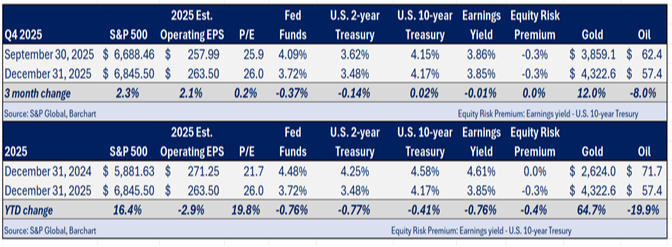
The Federal Reserve cut interest rates by 0.25% in September, October, and December, which supported equities. The U.S. 2-year Treasury yield declined 14 basis points to 3.48%, while the 10-year yield increased 2 basis points to 4.17%. Despite strength in risk assets, gold—often viewed as the ultimate safe haven and a “risk-off” asset—surged 12.0%, while oil plunged 8.0% over the same period.
Interest rates fell sharply in 2025 -- despite resilient economic growth and elevated inflation -- loosening financial conditions and driving risk assets higher. The U.S. 2-year Treasury yield dropped 77 basis points to 3.48%, while the 10-year yield declined 41 basis points to 4.17%. This drop in yields steepened the yield curve to 0.69% -- approaching its 50-year median of 0.80% and signaling a return to historically normal term premium relationships.
The U.S. economy demonstrated surprising resilience in the fourth quarter despite facing significant headwinds from the longest government shutdown in American history, tariff uncertainty, slowing labor market growth, and sticky inflation. The unemployment rate remained at a historically low 4.4%, while core inflation fell from 3.2% in December 2024 to 2.6%. Real GDP expanded by 2.3% year-over-year in the third quarter, and according to S&P, corporate profits grew by 12.7% in Q3 and are expected to grow by 12.9% in the yet to be reported Q4.
Despite solid equity returns and resilient economic data in 2025, gold's 64% gain signals underlying structural problems. This represents gold's highest annual return since 1979, when the energy crisis and double-digit inflation drove a 126% surge. Because gold acts as a currency, its 64% appreciation against the dollar indicates significant erosion of U.S. purchasing power. Thus, a significant driver of economic growth and market gains wasn't improving fundamentals, but currency debasement.
The debasement accelerated on August 22nd when Fed Chairman Powell, speaking at the Jackson Hole conference, pivoted toward prioritizing employment over inflation—signaling willingness to cut rates aggressively even if inflation remains elevated.From Powell’s dovish shift through today, gold appreciated 47.4% versus just 7.4% for the S&P 500.
In summary, stocks are priced for perfection. Valuations sit near record highs, analysts expect 17.8% earnings growth in 2026, the Fed is projected to cut rates twice, and the AI capex boom is assumed to keep driving the economy. We believe this optimism is misplaced—that AI mania and dollar debasement are masking a weak, overleveraged economy. Should AI capital spending slow or excessive monetary and fiscal policy push interest rates higher, both the economy and the stock market face significant downside risk.
Economic Outlook
As value investors, our asset allocation is driven by long-term valuation measures and the risk-reward opportunities present in the market. Moreover, we analyze leading economic and market indicators to determine the likely paths of economic growth and inflation. This enables us to strategically position our portfolio to perform well in all economic environments.
Despite solid economic growth and low unemployment in 2025, significant economic imbalances left many Americans feeling as if we were in a recession. Economic growth relied on three unsustainable pillars -- an unprecedented peacetime budget deficit, an AI capital expenditure boom, and consumption concentrated among the wealthiest 10%. In our view, these growth drivers are not sustainable, and the economy is not as strong as the headline numbers indicate.
In addition to these unsustainable economic drivers, affordability remains deeply problematic for most Americans. The inflation rate has moderated but still exceeds the Fed’s 2% target, while price levels remain elevated due to the Fed's failure to adequately shrink its bloated balance sheet after the pandemic. Chair Powell’s Jackson Hole pivot in August -- prioritizing employment growth over inflation -- was a clear monetary mistake that materially loosened financial conditions, fueled bubbles in stocks and real estate, and threatens to accelerate inflation in the months ahead.
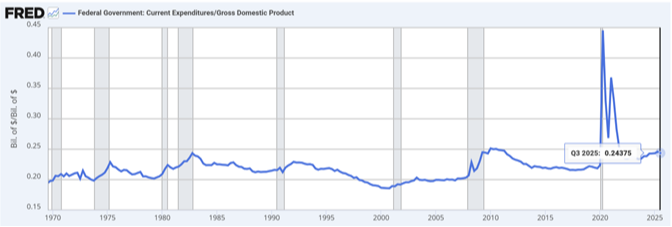
The first unsustainable driver of economic growth is the near-record peacetime budget deficit. Through the third quarter of 2025, government revenue grew 10.7% while spending increased 5.8% -- a favorable dynamic boosted by tariff collections. Yet despite this revenue surge, the deficit remains dangerously elevated at $1.8 trillion, or 5.8% of GDP. The root problem is government spending, not revenue. Government receipts stand at 18.5% of GDP -- slightly above the 55-year average of 17.9% -- while spending is 24.4% of GDP, a full 2.4 percentage points (or $746 billion) above the historical average of 22%. Most notably, despite unemployment at only 4.4%, government spending remains near recessionary levels—an imbalance that is not sustainable.
Through Q3 2025, government revenue growth (10.7%) outpaced spending growth (5.8%), aided by tariff revenue. Yet the deficit remains unsustainably large at $1.8 trillion (5.8% of GDP). The problem is spending, not revenue: government receipts at 18.5% of GDP sit above the 55-year average of 17.9%, while spending is 24.4% of GDP—2.4 percentage points above historical norms, or $746 billion annually. Importantly, this recessionary level of spending persists even though the unemployment rate is only 4.4%.
Source:FRED
The second unsustainable growth driver is the AI investment boom. Corporate spending on AI infrastructure -- data centers, advanced chips, networking equipment, and power capacity -- has surged since OpenAI launched ChatGPT in November 2022. According to the St. Louis Federal Reserve, AI-related investment contributed 0.97 percentage points to real GDP growth in the first three quarters of 2025, accounting for 39% of all economic growth. Notably, AI investment as a share of GDP now exceeds levels reached during the dot-com boom, suggesting the current cycle is potentially more fragile than the previous technology bubble.
In our view, this AI investment exhibits classic speculative-bubble features: ambitious, forward-looking projections, vendor-financed buildouts, and outrageous equity valuations. This mirrors prior booms: investor enthusiasm drives demand overestimation, leading to overcapacity and a market decline. History shows that while investors often suffer large losses when such booms burst, the excess infrastructure they leave behind can lower prices, expand access, and enable new applications that fuel later innovation waves. While the timing of any correction is unknowable, the structural vulnerability is clear since AI capex accounts for nearly 40% of reported GDP growth.
The AI boom has powered a massive stock market rally over the past three years, creating a “wealth effect” that represents our third unsustainable growth driver. AI mania, amplified by extremely loose financial conditions from the Fed, has pushed stocks and home prices to record highs. Since the top 10% of households own about 87% of publicly traded stocks and are more likely to own their homes, they have become wealthier and increased their spending. About half of all U.S. consumer spending now comes from the top 10% of households—a sharp increase from prior decades. We believe the Fed’s profligate monetary policy since the Pandemic has created asset bubbles in the financial markets and housing. When these bubbles inevitably burst, the wealthy will cut spending, leaving the economy vulnerable.
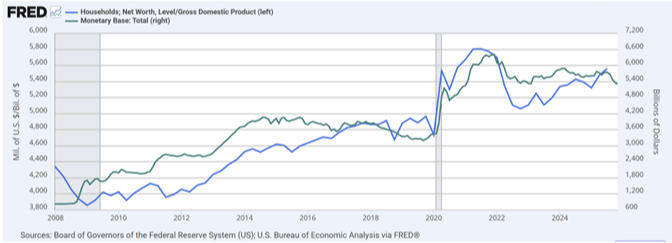
Since the Great Recession in 2008, the Fed has grown the monetary base from $830 billion to $5.3 trillion today, an annualized growth rate of 10.8%. This unprecedented monetary expansion has contributed to structural imbalances across the economy and fueled asset bubbles in the financial and housing markets. Economic growth has never been more dependent on the wealth effect from the elevated asset valuations, and when these bubbles inevitably burst, the economy will be vulnerable.
Source: FRED
Despite our longer-term growth concerns, the economy could experience a short-term surge driven by the "One Big Beautiful Bill Act" and the administration's explicit goal to run the economy "hot" during the mid-term election year. The OBBBA delivers substantial relief through exemptions on tips, overtime, and auto loan interest, while allowing businesses to immediately expense 100% of capital investments rather than depreciate them over time. Additionally, because the IRS did not update withholding tables in 2025, most taxpayers will receive large refunds when they file in early 2026. Morgan Stanley estimates that individual refunds will be about 20% higher than last year, boosting personal income and supporting consumption.
Also, the administration has proposed $2,000 direct payments to individuals funded by tariff revenue, and to address affordability, Trump announced plans to purchase $200 billion in mortgage debt to drive down mortgage rates, ban institutional investors from acquiring single-family homes, and cap credit card interest rates at 10%. This combination of tax cuts, refund windfalls, direct payments, and interventionist affordability measures could create a short-term surge, even as the underlying fiscal and structural concerns persist.
While the Trump administration wants to run the economy hot, the Fed has already accommodated them by cutting interest rates by 1.50% since September 2024 and resuming balance sheet expansion to $40 billion per month in December -- despite a 4.4% unemployment rate and inflation remaining above its 2% target for nearly 5 years. We are concerned that the Fed's pivot toward easier policy -- which has materially loosened financial conditions -- combined with pending fiscal stimulus and tariff pass-through effects, could reaccelerate inflation and lead to higher interest rates. Higher interest rates would have an adverse impact on our three unsustainable drivers and potentially burst the AI bubble.
Easy money, price controls, and market interventions perpetuate economic problems rather than solving them. Supply-side policies—lower taxes, deregulation, affordable energy—boost growth but cannot offset the structural damage from record deficits, the Fed's $6.6 trillion balance sheet, and market-distorting subsidies. Excessive government spending creates artificial demand that crowds out private investment, stifles competition, and inflates costs in heavily subsidized sectors such as healthcare and education. Sustainable prosperity requires free-market competition, fiscal restraint that restores spending to historical norms, and monetary discipline that ensures currency stability. In this type of economic environment, innovation and productivity will lead to sustainable growth and improved living standards.
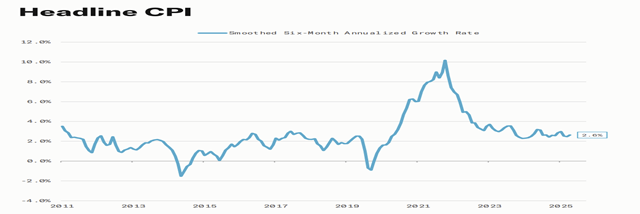
The Federal Reserve did not sufficiently unwind its emergency policies after the pandemic, leading to a significant rise in inflation that hit a 40-year high in 2022 and remains well above the Fed’s 2% target. Despite elevated inflation and a 4.4% unemployment rate, the Fed has cut interest rates by 1.5% and is again printing $40 billion each month. These easy financial conditions, coupled with increased fiscal stimulus and the lagged effect of the tariffs, could lead to higher inflation.
Source:EPB
In summary, the economy is more vulnerable than the headline numbers suggest. The U.S. economy's solid 2025 growth rests on three unsustainable pillars: near-record peacetime deficits (5.8% of GDP), AI capital spending driving 39% of economic growth, and consumption concentrated among the wealthiest 10% who benefit from the AI boom and the Fed-inflated asset bubbles. The AI mania exhibits classic bubble characteristics, while the economy has grown dangerously dependent on the wealth effect from inflated asset values. We are concerned that the Trump administration's "run it hot" strategy and the Fed’s easy monetary policy could push interest rates higher than the fragile economy can withstand.
Stock Market Outlook:
The stock market continues to offer a poor long-term risk-reward. The S&P 500 is extremely overvalued, with elevated concentration risk, as 10 mega-cap technology stocks account for 38% of the index's market value. Market breadth was weak in 2025: the median S&P 500 stock gained just 8.7%, while nearly 40% of companies posted negative returns. Meanwhile, gold’s 64% rally in 2025 -- it’s strongest in decades -- is not positive for risk assets -- it signals a growing loss of confidence in the dollar. Historically, sustained strength in gold has preceded episodes of market stress and volatility.
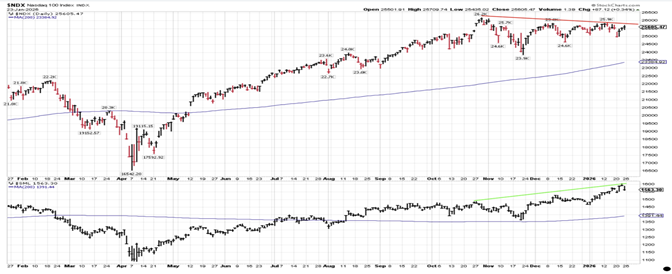
The Nasdaq 100 is approximately 67% technology and communication stocks and has been the market leader for the past three years. It advanced 20.8% in 2025 on the strength of AI-driven enthusiasm. However, the index reached its all-time high in October and has been unable to surpass that level for three months, even as the equal-weight S&P 500 and small-cap S&P 600 both achieved new highs on January 22nd. While a broad-based rally is typically a sign of a healthy market, we are concerned since leadership shifts of this nature have historically marked the initial phase of speculative bubbles unwinding.
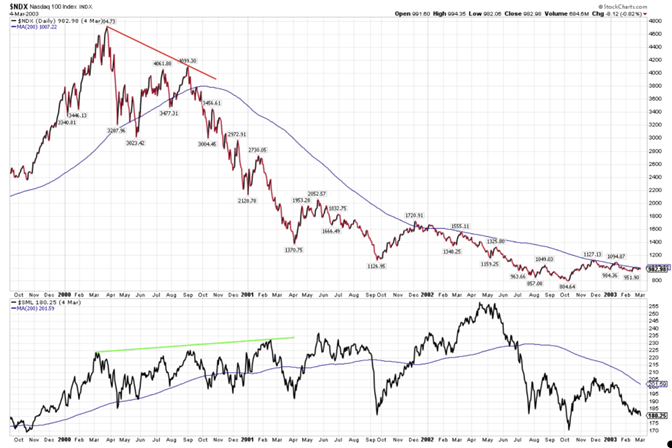
In 2000, the Nasdaq 100 peaked in March and plummeted 83% over the subsequent two and a half years as the internet bubble burst. Before the crash, stocks were extremely overvalued, market breadth was narrow, and technology stocks accounted for most of the market gains. After the March peak, leadership rotated sharply, and the broader market began to outperform the technology leaders. Many investors celebrated the improving breadth as a healthy sign; in hindsight, it marked the beginning of capital flight from overvalued tech names. While it is premature to declare the AI bubble has peaked, the current setup warrants watching, as this recent market action could be an early warning signal.
The Nasdaq 100 has led the market for the past three years, propelled by AI mania. Yet the index has failed to make a new high for roughly three months, while the broad-based, small-cap S&P 600 reached an all-time high this week. Many investors view this leadership shift and improving breadth as positive signs of market health. We are concerned that this change in leadership may represent the beginning of the end of the AI bubble.
Source:Stockmarketcharts.com
The Nasdaq 100 peaked in March 2000 and subsequently fell 83% over two and a half years as the internet bubble burst. The prelude to that collapse was eerily similar to today: extreme overvaluation, concentrated gains in technology, and narrow market breadth. After the March 2000 peak, market leadership rotated away from mega-cap tech, and broader indices began outperforming. Many pundits viewed this rotation as positive broadening, though in hindsight, it was the initial stage of massive capital reallocation from the Internet bubble.
Source:Stockmarketcharts.com
While we are concerned about this recent market rotation in the short term, we continue to believe the market’s record level of overvaluation will yield disappointing investment gains over the long term. As value investors, we believe that the price you pay most accurately determines your return on investment. While valuation models exhibit little predictive power over the short term, they correlate strongly with long-term returns over ten years or more.
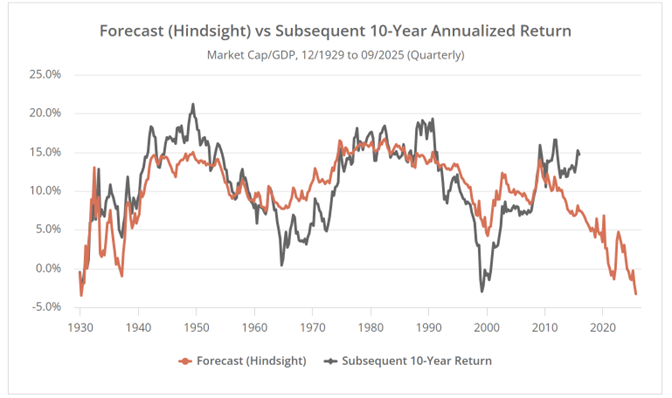
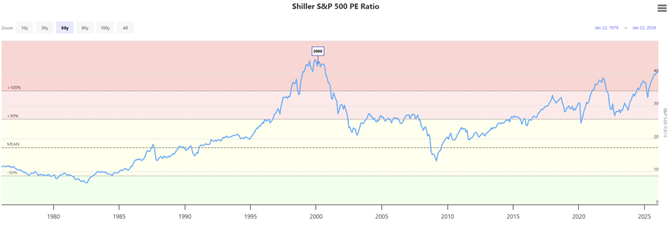
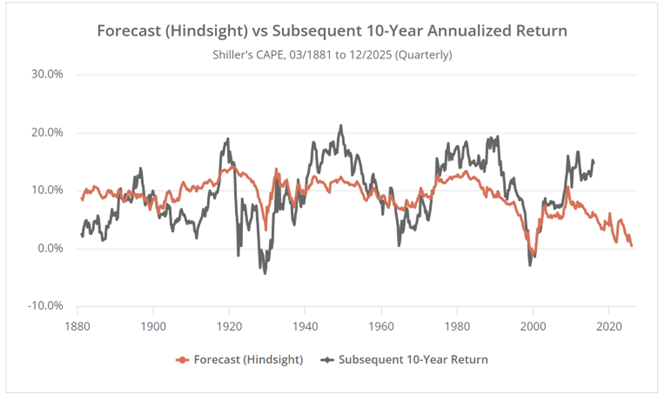
Two robust long-term valuation models—Market Value to GDP and Shiller’s CAPE—indicate that the S&P 500 is projected to deliver annual returns between -3.3% and 0.4% over the next decade. Given that 10-year Treasury Inflation-Protected Securities (TIPS) currently yield a real return of 1.95%, equities are substantially overvalued and present an unattractive risk premium.
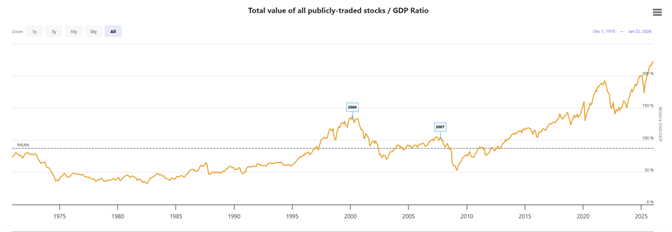
Market Value to GDP – "Still, it is probably the best single measure of where valuations stand at any given moment." –Warren Buffett, December 10, 2001. Based on market value to GDP, stocks are more than 100% higher than their historical average level and more expensive than during the 2000 technology bubble. Over the next ten years, the model forecasts an annual return for the S&P 500 of -3.3%.
Source: Longtermtrends.com, Allocate Smartly
Shiller's CAPE (a valuation measure that smooths out cyclical earnings fluctuations) indicates that stocks are more than 90% above their long-term average, and the 10-year expected return is about 0.4% per annum. Since the 10-year Treasury Inflation Protected Securities (TIPS) yield a real return of 1.95%, the S&P 500 has an inadequate risk premium.Over the next ten years, the model forecasts an annual return for the S&P 500 of 0.4%.
.
Source: Longtermtrends.com, Allocate Smartly
In 2025, the S&P 500 has gained roughly 17.7%, whereas the S&P 500 equal-weight index has risen only 11.2%, illustrating the extent to which recent gains are concentrated in a handful of mega-cap AI stocks. In January, the rotation from technology to the broad market reversed this dynamic. Through January 23rd, the S&P 500 has gained roughly 1.0%, whereas the S&P 500 equal-weight index has risen 3.8%.
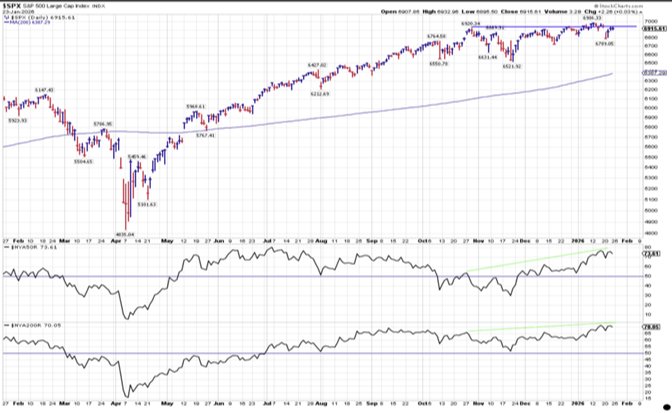
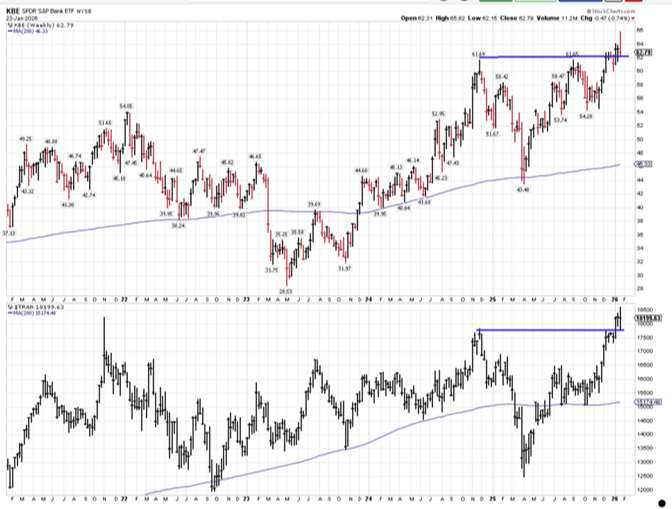
Although the S&P 500 has essentially traded sideways over the past three months, market breadth has greatly improved. In late October, when the S&P 500 reached an all-time high, only 54% of NYSE stocks were above their 50-day moving average, and only 67% were above their 200-day moving average. Currently, both breadth measures are above 70%. Additionally, the economically sensitive indices—the S&P Bank Index and the Dow Jones Transportation Average—reached all-time highs this week for the first time in over a year. This outperformance in key cyclical sectors could suggest underlying economic strength and acceleration consistent with the administration's "run it hot" strategy.
While the S&P 500 has traded sideways over the past three months, the broader market has improved, and now market breadth is healthy, and 70% of NYSE stocks are above their 50 and 200-day moving averages.
Source:Stockmarketcharts.com
While the S&P 500 has traded sideways over the past three months, the economically sensitive indexes—such as the S&P Bank Index and the Dow Jones Transportation Average—reached an all-time high for the first time in over a year. The recent outperformance of these key cyclical sectors signals underlying weakness and suggests that the overall economy may be accelerating, consistent with the Administration’s “run it hot” economy.
Source:Stockmarketcharts.com
In summary, our long-term view is that stocks offer a poor risk-reward, because overvaluation is extreme and the S&P 500 has significant concentration risk, as ten mega-cap technology stocks account for 38% of the index’s market value. Additionally, gold’s epic rally, which continued in January, is not a positive for risk assets. In the short term, the market’s recent breadth improvement and the relative strength of economically sensitive sectors are noteworthy. Typically, a broad-based rally is a sign of a healthy market. We are concerned that this leadership rotation away from tech may signal the beginning of capital flight from overvalued tech sector and the initial stage of the AI bubble bursting. In this uncertain environment, we expect international equities, value stocks, small and midcaps, and real assets to outperform the S&P 500.
Portfolio Review:
As value investors, our asset allocation is driven by long-term valuation measures and the risk-reward opportunities present in the market. Moreover, we analyze the leading economic and market-based indicators to determine the probable path of the rate of change for economic growth and inflation. This enables us to strategically position our portfolio to perform well in all economic environments.
Given the administration’s pursuit of aggressive fiscal stimulus in a mid-term election year, market breadth broadening, and cyclicals outperforming, we have tactically increased exposure to value and small-cap equities while keeping technology underweight. We are positioning for reflationary conditions—rising nominal growth paired with elevated inflation.
Our investment framework prioritizes assets with historically favorable performance in such environments: international and EM stocks (dollar-depreciation beneficiaries), value equities (benefiting from accelerating growth), hard assets, including gold and commodities (direct inflation hedges and weak-dollar hedges), and short-duration fixed income (mitigating rate risk). This allocation seeks to participate in short-term policy-driven economic momentum while maintaining hedges against the structural fragilities we've identified: unsustainable deficits, speculative AI investment, and consumption dependent on inflated asset prices.
We plan to maintain a highly diversified and balanced asset allocation until economic uncertainty diminishes and equities present a more favorable risk-reward opportunity.
Current Risk-Weighted Portfolio
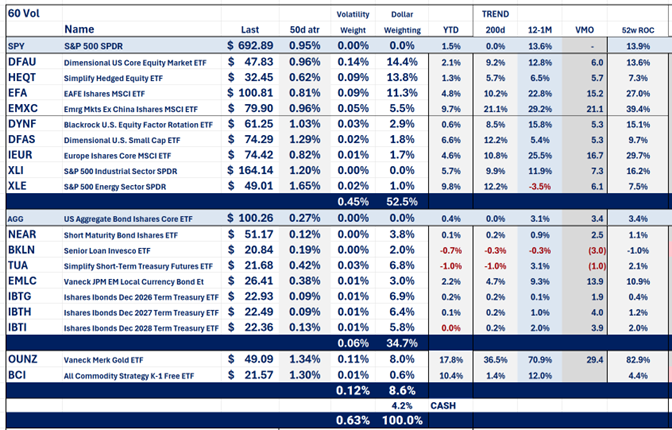
Our portfolio's risk level (annualized volatility) is 10.0%.
Our 60\40 benchmark has a historical risk level of 10.7% and a current risk level of 10.9%.
Disclaimer:The material in this newsletter is for educational purposes only and should not be considered investment advice or a recommendation of any particular security, strategy, or investment product. This newsletter is not a substitute for professional investment services. Past performance is no guarantee of future results, and there is no assurance that investment objectives will be achieved. Information contained herein has been obtained from sources believed to be reliable but not guaranteed. ALL INVESTMENTS CONTAIN RISK.

